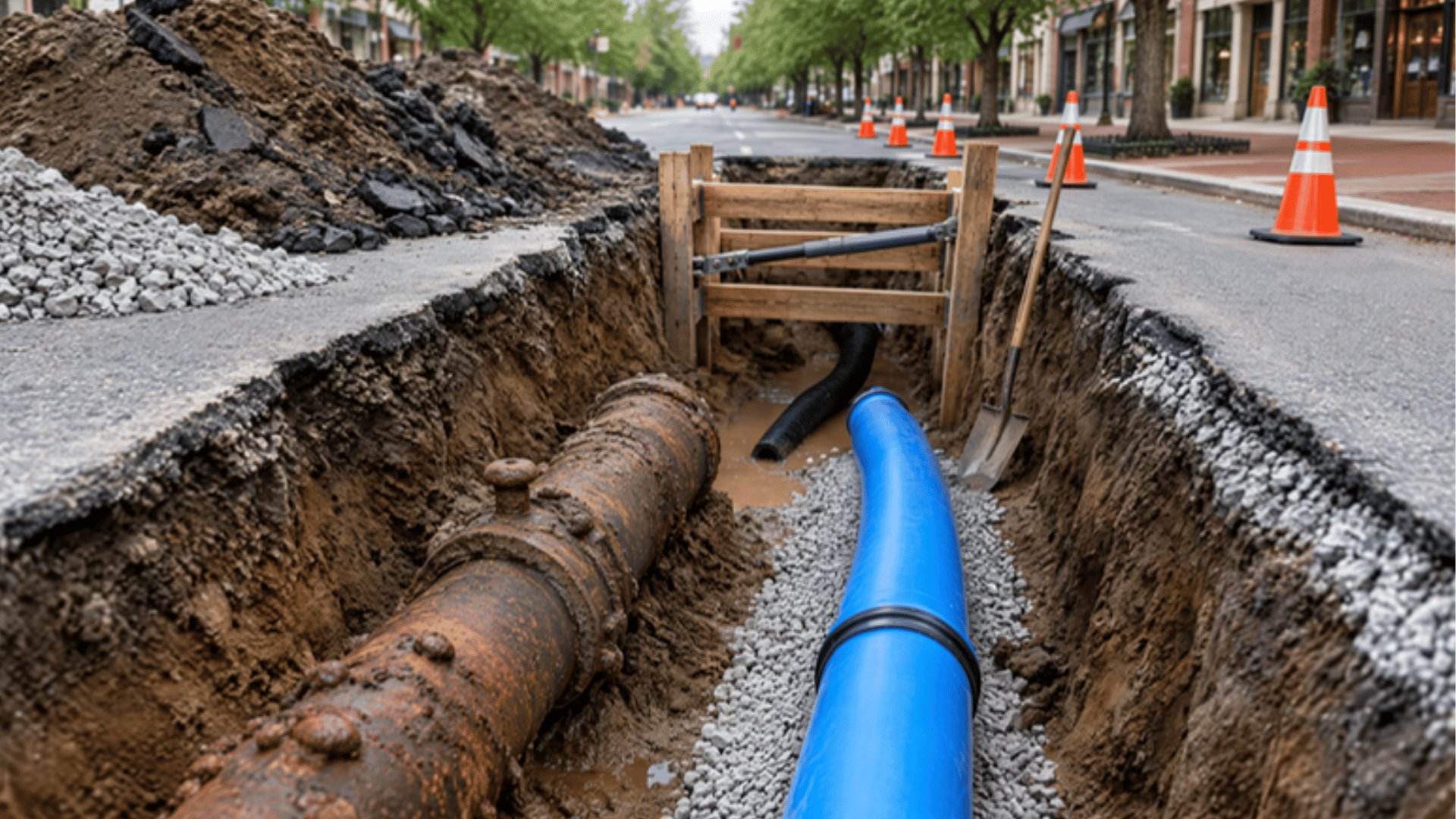
Under downtown Chico this week, crews from Cal Water are pulling out water mains that have been in the ground for more than 80 years. About 90 miles south, the Sacramento County Water Agency just wrapped up a decade-long project that replaced 38 miles of aging pipe in the Arden area. Both stories point at the same quiet fact: the water you drink spends the last leg of its journey inside pipes that may be older than your house, and the age of those pipes shapes what comes out of the faucet.
What's happening under Chico, and closer to home
The Chico Enterprise-Record reported on November 14 that Cal Water is beginning a main replacement in downtown Chico, starting with a 3,100-foot stretch of West Fifth Street between Salem and Orange streets. The plan is to eventually replace every main between Second and Seventh streets in that corridor, an area dense with college housing. Chico District Manager Evan Markey told the paper crews will be there "for a while."
In a March 2025 release, Cal Water said its Chico system contains about 415 miles of main and that it replaces roughly 12,000 feet a year. At that pace, working through the whole system would take well over a century, which is why utilities rank pipes by age, material and leak history and replace the worst first.
The Sacramento region is in the same situation. On August 11, 2026, Sacramento County announced that its Water Agency had finished the Arden Service Area Pipe and Meter Installation Project, the biggest construction job in the agency's history. Over ten years it abandoned old mains that ran through backyards, laid about 38 miles of new pipe in the streets, and installed more than 3,000 meters. The county said the old system was "in danger of pipe material failure and leaks." The City of Sacramento, meanwhile, moves its drinking water through 1,727 miles of pipe, a mix of plastic, ductile iron and cast iron.
Why pipe age matters
The American Society of Civil Engineers gave U.S. drinking water infrastructure a C- in its 2025 Report Card. The group counts roughly 240,000 water main breaks a year nationwide, costing about $2.6 billion in repairs, and it reports that the average life expectancy of a pipe in service has dropped to 78 years. That is almost exactly the age of the Chico mains coming out of the ground.
California scored worse than the country. In December 2025, ASCE's California Section downgraded the state's drinking water from a C in 2019 to a D+, noting that more than 85 percent of water utilities rely on components older than their design life and that leaking pipes lose about 105 billion gallons of water a year statewide.
What an old main does to the water in your house
A water main does not change what the treatment plant sends out, but it can add things along the way.
Cast iron, the standard pipe material for much of the twentieth century, corrodes slowly from the inside. Over decades it grows a rough crust of rust, called tuberculation, that narrows the pipe and traps iron and manganese sediment. Most days that layer stays put. When flow suddenly changes, during hydrant flushing, a main break, or construction like Chico's, it shakes loose and shows up at the tap as rust-colored or cloudy water for a few hours.
Breaks and leaks matter for a second reason: pressure. A water system stays clean partly because it is always pushing outward. When a main breaks and pressure drops, soil water around the pipe can seep in through the same cracks, which is why utilities issue precautionary boil-water notices after large breaks even before any test comes back.
Many later subdivisions were plumbed with asbestos-cement pipe instead; West Sacramento's Linden Acres project specifically called out replacing AC mains from the early 1980s.
What new pipe will not change: hardness, chlorine and chloramine. Those come from the source water and the treatment plant, not the pipe, so a brand-new main under your street still delivers the same mineral scale on fixtures and the same chlorine that leaves hair dry and skin tight after a shower.
How to check what your pipes are doing
Start with your utility's annual Consumer Confidence Report, which often lists main replacement projects and any discolored-water events. If you want the specific age and material of the main on your street, call the utility's water quality line and ask; most keep that in a map. The EWG Tap Water Database lets you look up test results by zip code. At home, if you notice discolored water after street work, run a cold tap for a few minutes until it clears, and skip the hot side so sediment does not settle in the water heater.
For the day-to-day effects of aging pipes, whole-home filtration is designed to catch sediment, rust and the chlorine or chloramine added at the plant, and a softener addresses the hardness that no pipe replacement will fix. Reverse osmosis at the kitchen sink is designed for dissolved contaminants a sediment filter cannot touch, including lead, nitrates and PFAS.
Curious what's in your water? Book a complimentary water test — about 30 minutes, no obligation.
Healthier water, healthier family.
Sources
- Chico Enterprise-Record, "Cal Water to replace 80-year-old pipes in downtown Chico," Nov. 14, 2026 — https://www.chicoer.com/2026/11/14/cal-water-to-replace-80-year-old-pipes-in-downtown-chico/
- Cal Water, "California Water Service Begins Water Infrastructure Upgrade to Improve Water Supply Reliability and Fire Protection in Chico," March 25, 2025 — https://www.calwatergroup.com/news/press-releases/detail/665/california-water-service-begins-water-infrastructure-upgrade-to-improve-water-supply-reliability-and-fire-protection-in-chico
- Sacramento County, "Sacramento County Water Agency Wraps Up 10 Year Water Meter and Pipe Improvement Project," Aug. 11, 2026 — https://www.saccounty.gov/us/en/articles/2026-articles/sacramento-county-water-agency-wraps-up-10-year-water-meter-and-.html
- City of Sacramento Department of Utilities, "Your Utilities. Your Partner." (July 2020) — https://cityofsacramento.org/-/media/Corporate/Images/Features/Utilities/DOUPartnerReport7-20WEB-7th-issue.pdf
- American Society of Civil Engineers, "2025 Report Card for America's Infrastructure: Drinking Water," March 25, 2025 — https://infrastructurereportcard.org/wp-content/uploads/2025/03/Drinking-Water.pdf
- American Society of Civil Engineers, "ASCE California Section releases infrastructure report card," Dec. 3, 2025 — https://www.asce.org/publications-and-news/civil-engineering-source/society-news/article/2025/12/03/asce-california-section-releases-infrastructure-report-card
- City of West Sacramento, "Linden Acres Water Main Replacement Project" — https://www.cityofwestsacramento.org/government/departments/capital-projects-department/projects/linden-acres-water-main-replacement-program