
This week the Bay Area Air Quality Management District gave homeowners in Marin, Sonoma and the rest of the nine-county region one more year before new gas water heaters are phased out, moving the deadline from January 2027 to January 2028. If your water heater is getting old, that puts a big purchase on the calendar, and most people never think about one thing when they shop for it: the water that will sit inside it every day.
What the Air District decided
The Air District's Rule 9-6 has limited pollution from gas water heaters since 1992. In 2023 the board tightened it to a "zero-NOx" standard, which in practice means a heat pump or other electric unit when a gas one wears out. On November 4, 2026, the board delayed that requirement to January 2028, and to January 2033 for multifamily buildings, deed-restricted affordable housing, and larger or specialty units. Small tanks, mobile homes, low-income households and homes with electrical panels under 100 amps are exempt, and nobody has to remove a working appliance; the rule applies only when you replace one.
The reason is air quality. The Air District's analysis attributes as many as 85 premature deaths and 15,000 asthma attacks a year in the Bay Area to pollution from gas water heaters and furnaces. "Water heaters are a significant source of air pollution in the Bay Area," said the District's executive officer, Dr. Philip Fine.
Why the water matters as much as the heater
The U.S. Department of Energy puts water heating at about 18 percent of a typical home's energy use, usually the second-largest energy expense in the house. That makes the tank's efficiency worth protecting, and its biggest everyday threat is scale.
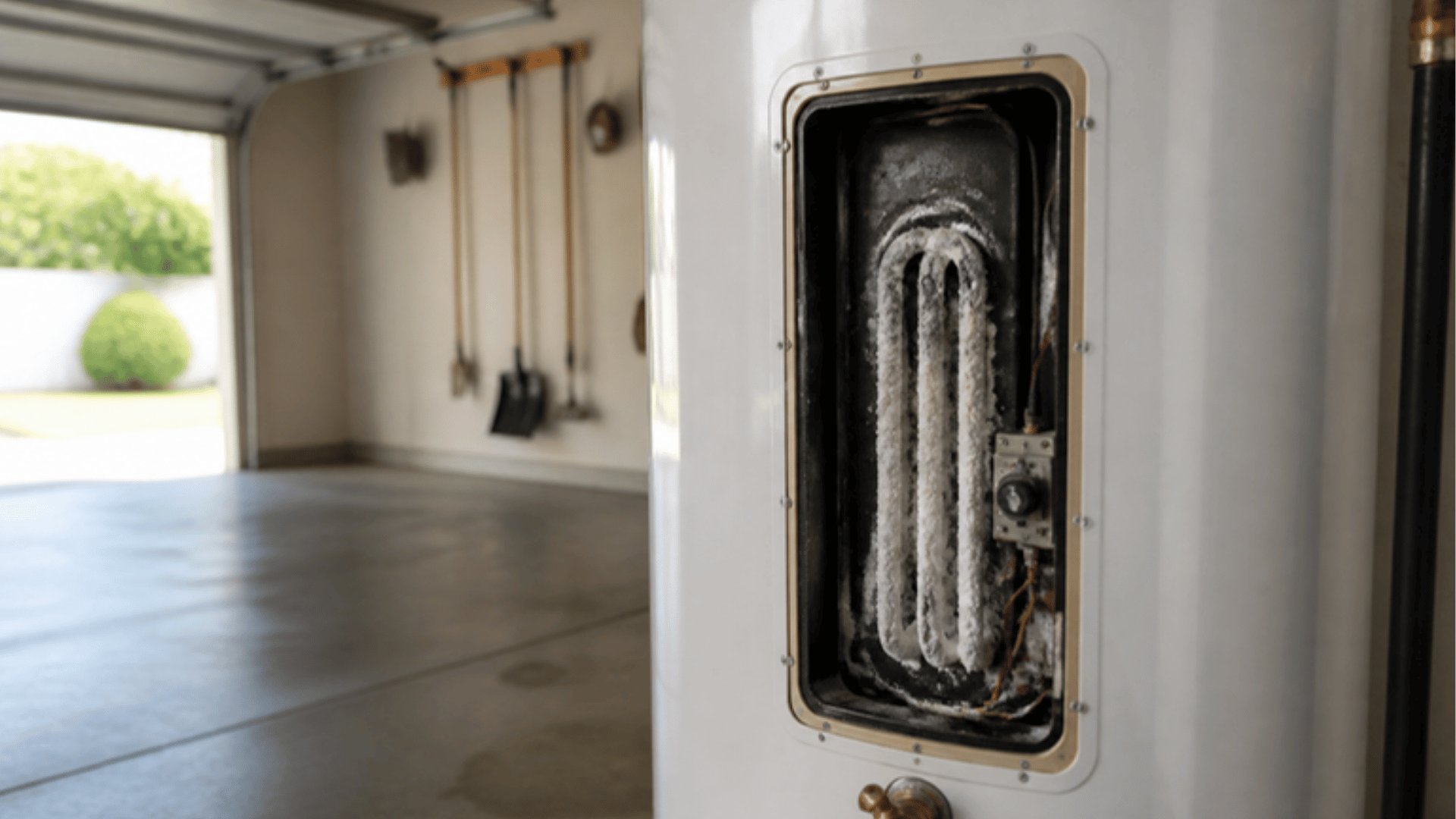
The U.S. Geological Survey explains it simply: when hard water is heated, as in a home water heater, solid deposits of calcium carbonate form. That chalky layer settles on the bottom of a tank or coats the heating element, so the heat has to work through rock before it reaches the water. USGS notes the scale lowers efficiency, raises the cost of heating water, and can shorten the life of the equipment.
How much? A 2009 study by Battelle Memorial Institute, commissioned by the Water Quality Research Foundation, found that untreated hard water can cause water-heating efficiency losses of up to 24 percent. The same study found hard water clogged showerheads in as little as a year and a half, while fixtures and appliances on softened water performed nearly as well at the end of testing as on day one.
Heat pump water heaters raise the stakes. DOE says they can be two to three times more efficient than a standard electric tank, but they cost more up front, so a tank that scales up early is a more expensive problem. They also need a space that stays between 40 and 90 degrees, which is why many end up in garages, where sediment flushing tends to get forgotten.
How hard is the water around here?
Hardness is reported as milligrams per liter (mg/L) of calcium carbonate or in grains per gallon. USGS calls water soft up to 60 mg/L, moderately hard from 61 to 120, hard from 121 to 180, and very hard above 180.
Marin Water's 2024 Annual Water Quality Report gives a useful local picture. Water from the district's own Mt. Tamalpais reservoirs averaged 58 mg/L, about 3.4 grains per gallon, at the top of the soft range. Water it buys from Sonoma Water's Russian River system averaged 123 mg/L, or 7.2 grains per gallon, squarely in the hard category. That same Russian River supply serves Santa Rosa, Petaluma and much of Sonoma County.
In the Sacramento region, hardness varies by city and by whether your water comes from Folsom Lake and the American River or from groundwater wells, which tend to run harder. The quickest way to find your number is your utility's annual Consumer Confidence Report, which lists hardness in the secondary standards table. The water tells you too: white crust on faucets and showerheads, cloudy glassware, and a tank that pops and rumbles as it heats are all scale talking.
Protecting whatever you install
Whether you keep a gas tank until it dies or move to a heat pump unit, two habits apply. First, flush sediment from the tank periodically; DOE notes that routine maintenance can significantly extend a water heater's life, and the owner's manual spells out how. Second, deal with hardness before it reaches the tank. A whole-home softener removes the calcium and magnesium that form scale, protecting the water heater, dishwasher and showerheads at once. Whole-home filtration can also take out chlorine and chloramine, the disinfectants that leave skin and hair dry, along with sediment and off tastes and odors. For drinking water, reverse osmosis at the kitchen sink handles the dissolved contaminants a softener does not, such as nitrates, PFAS and lead.
A new water heater is a 10-to-15-year decision. Knowing your water's hardness first is a free way to protect it.
Curious what's in your water? Book a complimentary water test — about 30 minutes, no obligation.
Healthier water, healthier family.
Sources
- Contra Costa News (Air District press release), "Air District Board of Directors Adopts Water Heater Rule Amendments, Delays Implementation to January 2028," November 4, 2026 — https://contracosta.news/2026/11/04/air-district-board-of-directors-adopts-water-heater-rule-amendments-delays-implementation-to-january-2028
- CalMatters (via Palo Alto Online), "New deadline for phaseout of gas water heaters gives Bay Area homeowners one more year," November 5, 2026 — https://paloaltoonline.com/calmatters/2026/11/05/new-deadline-for-phaseout-of-gas-water-heaters-gives-bay-area-homeowners-one-more-year
- U.S. Geological Survey, "Hardness of Water," updated August 24, 2026 — https://www.usgs.gov/water-science-school/science/hardness-water
- U.S. Department of Energy, Energy Saver, "Water Heating" — https://www.energy.gov/energysaver/water-heating
- U.S. Department of Energy, Energy Saver, "Heat Pump Water Heaters" — https://www.energy.gov/energysaver/heat-pump-water-heaters
- Water & Wastes Digest, "Results of Battelle Study Available Online," March 17, 2010 — https://www.wwdmag.com/home/news/10914910/results-of-battelle-study-available-online
- Marin Water, "2024 Annual Water Quality Report," April 2025 — https://marinwater.org/wp-content/uploads/2025/04/AWQR_English_2024.pdf