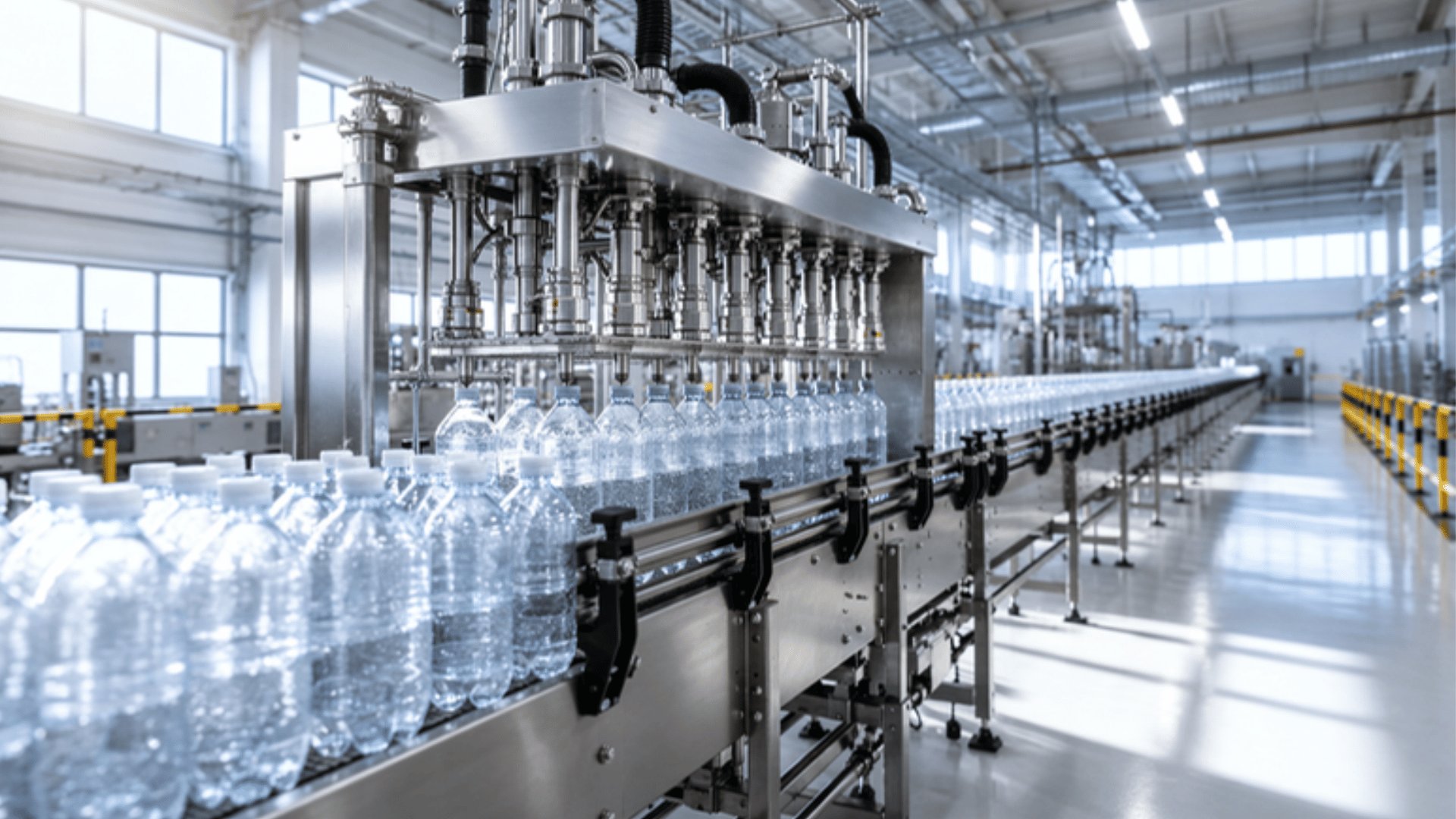
The old Budweiser brewery in Fairfield is about to become a bottling plant. On Tuesday night, the Fairfield City Council voted 6-1 to supply city water to Streamfill Packers, the American arm of Nongfu Spring, China's largest bottled water company. It's a good moment to answer a question many homeowners quietly wonder about: what is actually in a bottle of water, and how different is it from your kitchen tap?
What Fairfield approved
The 15-year agreement lets Streamfill draw an average of 1.65 million gallons of city water per day, roughly 10 percent of Fairfield's daily use, according to the California Globe. Nongfu Spring plans to invest about $200 million in the former Anheuser-Busch plant on Busch Drive and create around 130 jobs, the Napa Valley Register reported. Vice Mayor Pam Bertani cast the lone no vote.
Anheuser-Busch opened the brewery in 1976 specifically because of Lake Berryessa's water quality, and Fairfield's supply today is split between Lake Berryessa and the Sacramento-San Joaquin Delta. That's the same kind of surface water that feeds most taps across the Sacramento region and the North Bay: a reservoir or river, treated at a city plant and sent through the pipes.
So the water going into those future bottles starts out as ordinary municipal tap water. That turns out to be the norm, not the exception.
Most bottled water starts at a city tap
Food & Water Watch's "Take Back the Tap" report found that nearly 64 percent of bottled water sold in the United States comes from municipal supplies. Only about a third is spring water drawn from a protected underground source. The rest is city water that a company buys at commercial rates, runs through its own treatment line, and sells back in single-serve plastic.
The report put the price gap at roughly 2,000 times: about $9.50 a gallon by the bottle versus a fraction of a penny at the tap. Consumer Reports has noted that 40 percent of Americans believe bottled is safer than tap, even though tap water is regulated by the EPA with more frequent public reporting, while bottled water is regulated by the FDA as a packaged food.
None of this means bottled water is bad. It means the real difference between the bottle and your faucet is the treatment step in between.
What a bottling line does to tap water
Here is the part most people never see. When a bottler takes in city water, it usually runs it through the same sequence a well-designed home system uses:
- Activated carbon pulls out chlorine and chloramine, the disinfectants every utility adds to keep water safe in the pipes. Chlorine is also the main reason tap water can taste or smell like a pool, and why some people notice dry hair and dry skin after showering.
- Reverse osmosis pushes water through a membrane with pores so small that dissolved minerals, salts, nitrates, PFAS, lead, and other dissolved contaminants are left behind. This is what lets a company sell "purified water" under FDA rules.
- A polishing step, often ozone or UV light, right before filling.
Reverse osmosis is the workhorse. The membrane separates water molecules from almost everything dissolved in them, then flushes the concentrated leftovers down a drain line. That's why RO is the standard tool for the contaminants that show up most often in Sacramento-area and North Bay test results: nitrates, PFAS, and metals like lead and chromium-6. An under-sink RO system does exactly what the bottling plant does, minus the truck, the shelf, and the bottle.
The bottle adds something of its own
In January 2024, researchers at Columbia University and Rutgers used a new laser microscope to count plastic particles in three popular U.S. bottled water brands. The average liter held about 240,000 detectable plastic fragments, and roughly 90 percent of them were nanoplastics, particles smaller than a micrometer. That was 10 to 100 times higher than earlier estimates that could only see larger microplastics.
The study's lead author told the Associated Press that much of the plastic appears to shed from the bottle itself and from the plastic membranes used in bottling. Several of the authors said they cut back on bottled water afterward and leaned more on filtered water at home.
Scientists are still working out what nanoplastics do in the body. The point is that bottled water is treated tap water plus a plastic container, and the container is part of what you drink.
How to check your own water
If you've been buying bottled water because you aren't sure about your tap, the better first step is finding out what's actually in it:
- Look up your zip code in the EWG Tap Water Database, which pulls the test results your utility already reports to the state.
- Read your utility's annual Consumer Confidence Report. Look for hardness, chlorine or chloramine, nitrate, disinfection byproducts, and any PFAS results.
- Test at the tap. Utility numbers describe water leaving the plant; your home's pipes and fixtures can change it.
Once you know your numbers, you can decide whether a carbon filter, a softener, or an RO unit does the job, and skip the bottle entirely.
Curious what's in your water? Book a complimentary water test — about 30 minutes, no obligation.
Healthier water, healthier family.
Sources
- Napa Valley Register (Bay City News Service), "Fairfield swaps beer for tea; beverage giant to take over Budweiser factory," Nov. 19, 2026 — https://napavalleyregister.com/news/regional/budweiser-fairfield-beverage-nongfu-spring/article_0da4cbee-1934-443a-83ee-ce1c4b7c8a5e.html
- SFGate, "Fairfield: City Swaps Beer For Tea As Beverage Giant Takes Over Budweiser Factory," Nov. 19, 2026 — https://www.sfgate.com/news/bayarea/article/fairfield-city-swaps-beer-for-tea-as-beverage-22538611.php
- California Globe, "Fairfield Votes to Give Chinese Company 10% of Water Supply for Planned $200 Million Beverage Plant at Former Budweiser Site," Nov. 2026 — https://californiaglobe.com/fr/fairfield-votes-to-give-chinese-company-10-of-water-supply-for-planned-200-million-beverage-plant-at-former-budweiser-site/
- Food & Water Watch, "Take Back the Tap: The Big Business Hustle of Bottled Water," Feb. 2018 — https://foodandwaterwatch.org/rpt_1802_tbttbigwaterhustle-web
- Consumer Reports, "Should We Break Our Bottled Water Habit?" — https://www.consumerreports.org/bottled-water/should-we-break-our-bottled-water-habit/
- Columbia Climate School, "Bottled Water Can Contain Hundreds of Thousands of Previously Uncounted Tiny Plastic Bits, Study Finds," Jan. 8, 2024 — https://news.columbia.edu/news/bottled-water-can-contain-hundreds-thousands-previously-uncounted-tiny-plastic-bits-study
- Associated Press via CBC, "When you drink bottled water, you're drinking lots and lots of nanoplastics," Jan. 10, 2024 — https://www.cbc.ca/1.7079302