
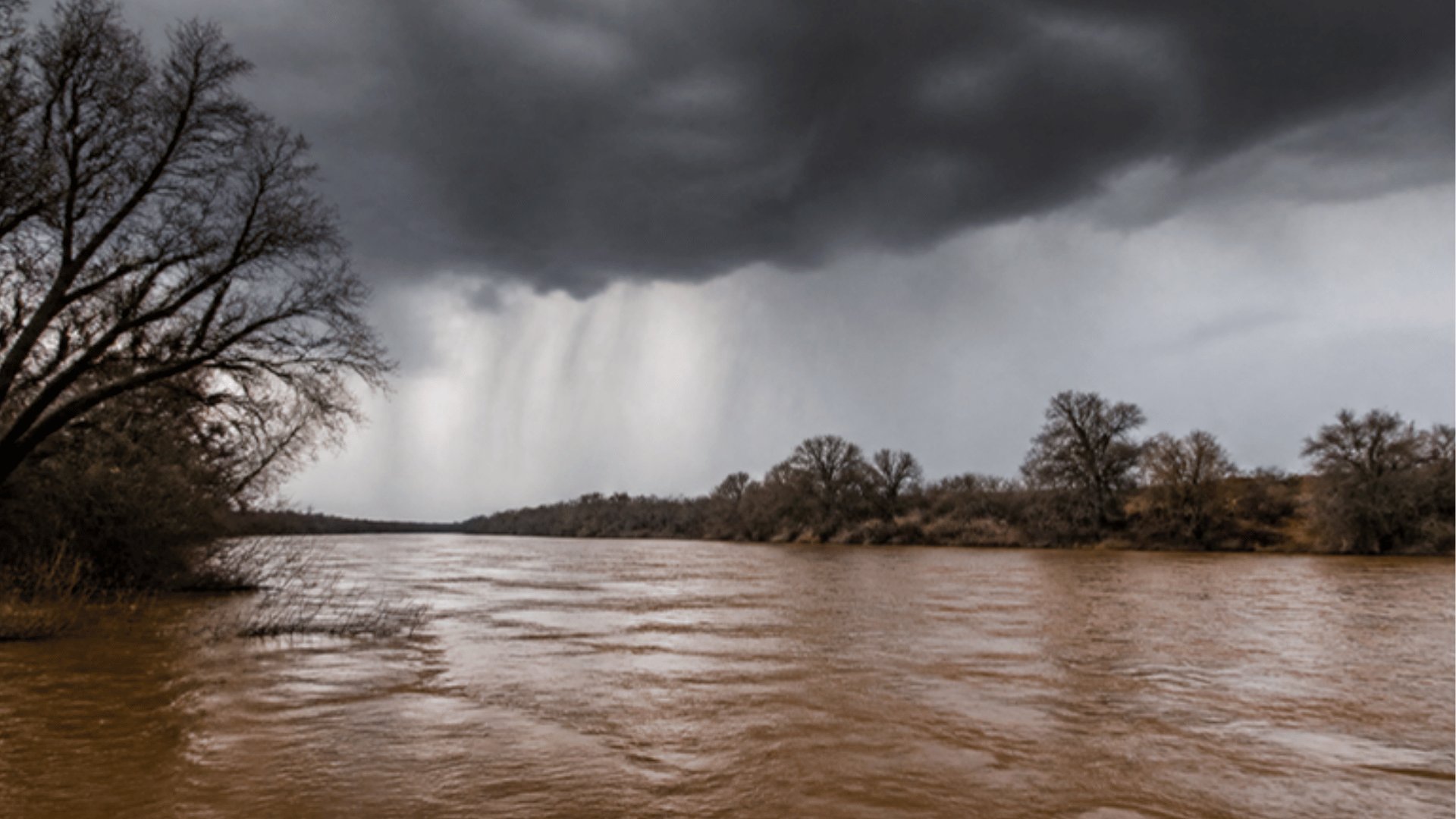
The rain is finally on the calendar. The Sacramento Bee reported on November 5 that the first atmospheric river of this El Niño season is taking shape for roughly November 11 through 16, and early projections show Sacramento could pick up nearly two inches, its entire November average, in a day or two. Most of us think about storms in terms of gutters, commutes and Sierra snow. But a big storm also changes the water your utility is treating, and that shows up at your kitchen faucet in a few quiet ways.
What a storm does to the river before it reaches the plant
Sacramento-area tap water starts as river water. The City of Sacramento draws from the Sacramento River and from the American River at its E.A. Fairbairn plant; Folsom, Roseville and much of Placer and El Dorado counties draw from Folsom Lake and the American River above it. When the first real rain of the season hits months of dry hillsides, it carries soil, leaf litter and whatever has built up on streets and in creek beds straight into those rivers.
The result is a jump in turbidity, which the EPA defines simply as "a measure of the cloudiness of water." Turbidity matters because the particles that make water cloudy can shield microorganisms from disinfectant, which is why federal rules treat it as a key test of how well a filter plant is working. The first storm after a dry stretch is often the muddiest of the year.
The storm also raises dissolved organic carbon, the invisible tea-colored stuff that comes from decomposing leaves and plants. University of Maine researchers who sampled lakes before and after severe rainstorms found that in some water bodies organic carbon spiked briefly and settled back within days, while in others it rose and stayed high, which is why they concluded utilities "might have to modify treatment strategies following extreme storms."
How the treatment plant responds, and what you might notice
Treatment plants are built for this. Sacramento's process runs river water through a grit basin, adds coagulants so fine particles clump together, lets the clumps settle out, then pushes the water through sand and anthracite filters before disinfection. After a storm, operators typically add more coagulant and, often, more chlorine or chloramine to keep the water safe on its trip through miles of pipe.
That extra disinfectant is the part a household is most likely to notice. Water can taste or smell more strongly of chlorine for a few days after a storm, and people who are sensitive to it may notice drier skin and drier, brittle-feeling hair in the shower, since chlorine strips the natural oils that protect both.
There is a second, less obvious effect. As the Calaveras County Water District explains on its water-quality page, chlorine reacts with the natural organic carbon in river water to form disinfection byproducts. Two families of these compounds, total trihalomethanes (TTHMs) and haloacetic acids (HAA5), are tracked by every utility; the EPA caps them at 80 and 60 parts per billion respectively. More organic carbon in the source water plus more chlorine to treat it is exactly the recipe that pushes byproduct levels up.
Why this matters more in a strong El Niño year
This is forecast to be a big winter, not a single storm. Forecasters are watching a strong El Niño pattern that could bring a long parade of atmospheric rivers to Northern California, and the Bee notes that "many areas could quickly see a month's worth of rain in just a few days." Each round of heavy rain repeats the cycle: a muddy, carbon-rich river, a plant leaning harder on coagulant and chlorine, and tap water that tastes, smells and feels a little different than it did in the dry season.
For homes on private wells, especially in the foothills of El Dorado and Placer counties, storms raise a different question. Surface flooding around a wellhead can carry bacteria and nitrates into a well that tested clean in the fall, so the first big storm of the year is a sensible time to put a bacteria test on the to-do list.
How to check what's happening in your own water
Your utility's annual Consumer Confidence Report lists turbidity results and the average and highest readings for TTHMs and HAA5. EWG's Tap Water Database (ewg.org/tapwater) lets you search by zip code and shows the same contaminants alongside health-based guidelines. And if you notice a stronger chlorine smell after this storm, that is not your imagination; it is the plant doing its job with harder-to-treat water.
At home, a whole-house carbon filtration system is designed to take out chlorine, chloramine and sediment before water reaches your showers and taps, which is what addresses the taste, odor and dry-skin side of storm season. Reverse osmosis at the kitchen sink is designed for the dissolved contaminants that carbon alone does not catch, including nitrates, PFAS, lead and disinfection byproducts, so the water you drink and cook with stays consistent no matter what the river is doing that week.
Curious what's in your water? Book a complimentary water test — about 30 minutes, no obligation.
Healthier water, healthier family.
Sources
- The Sacramento Bee (Sean Macaday), "The first atmospheric river of Super El Niño is coming. Here's when it could hit," November 5, 2026 — https://www.sacbee.com/news/weather-news/article317907097.html
- U.S. EPA, "National Primary Drinking Water Regulations" (turbidity, TTHM and HAA5 limits), updated August 2026 — https://www.epa.gov/ground-water-and-drinking-water/national-primary-drinking-water-regulations
- City of Sacramento Department of Utilities, "Water Treatment Process" — https://cityofsacramento.gov/utilities/water-quality/water-treatment-process
- Calaveras County Water District, "Disinfection Byproducts" — https://www.ccwd.org/disinfection-byproducts
- University of Maine via Smart Water Magazine, "Understanding the effect of severe rainstorms on freshwater ecosystems," April 24, 2019 — https://smartwatermagazine.com/news/university-maine/understanding-effect-severe-rainstorms-freshwater-ecosystems
- Maven's Notebook, "Weekly Water News Digest for Nov. 1-6" (El Niño and atmospheric river outlook), November 6, 2026 — https://mavensnotebook.com/2026/11/06/weekly-water-news-digest-for-nov-1-6-sites-reservoir-water-right-permit-approved-by-water-board-the-delta-in-a-changing-climate-could-el-nino-trigger-an-arkstorm-california-fac/