
On Wednesday, California American Water announced it had started pumping drinking water from a rehabilitated well in Seaside, on the Monterey Peninsula, after building a treatment facility for one specific metal: mercury. That is an unusual headline for a water utility, and a good excuse to talk about a contaminant most Sacramento-area families only hear about on fish advisories. Here is where mercury comes from in Northern California, why it mostly stays out of your tap, and when it is worth checking.
What happened in Seaside
The well, known as ASR Well 4, is part of a program that stores excess winter flows from the Carmel River underground in the Seaside Groundwater Basin for use in dry months. According to the company's November 18 release, the well went into production only after rehabilitation and the commissioning of a new mercury treatment facility, which it calls "an additional treatment barrier designed to protect drinking water quality."
The backstory is in a 2022 filing with the California Public Utilities Commission. Samples taken from the well in June and July 2021 contained mercury, and the company's working theory was that pushing water into the aquifer and pulling it back out caused an "atypical release of naturally occurring mercury" from the surrounding rock. Rather than abandon the well, the utility built treatment for it.
The federal and California limit for mercury in drinking water is 2 parts per billion. EPA lists erosion of natural deposits as a major source, along with refinery and factory discharges and runoff from landfills and croplands, and links long-term exposure above the limit to kidney damage.
The Gold Rush left roughly 10 million pounds of mercury in the Sierra
Northern California has its own mercury story, and it starts in 1849. Miners used liquid mercury, called quicksilver, to capture fine gold. A U.S. Geological Survey fact sheet explains that hundreds of pounds of mercury went into a typical hydraulic-mine sluice, and that 10 to 30 percent of it washed away every season. Statewide, USGS estimates placer mining lost about 10 million pounds of mercury, 80 to 90 percent of it in the Sierra Nevada, plus another 3 million pounds at hardrock mines.
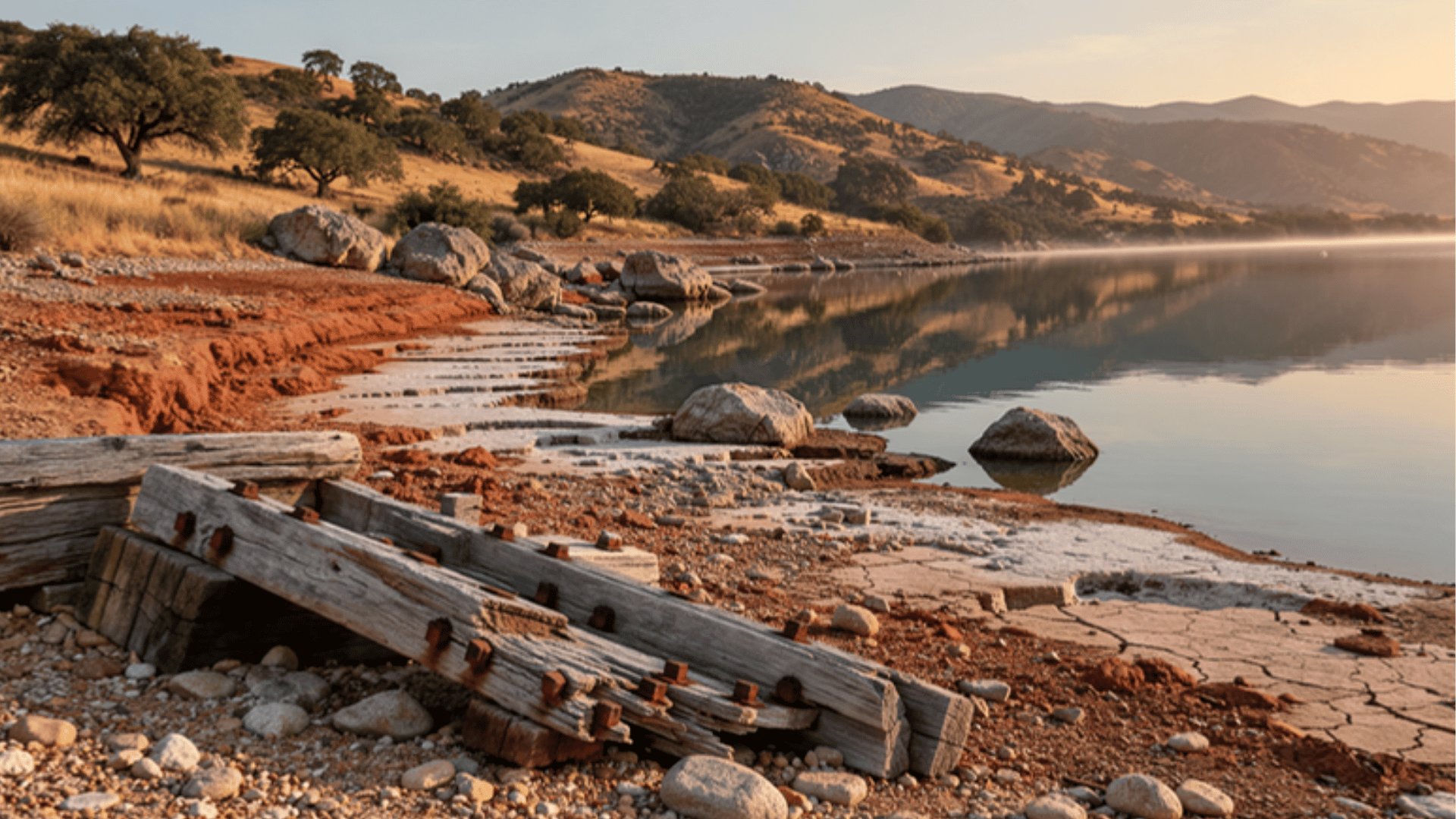
Much of that mercury is still out there, bound up in creek beds and reservoir sediment. The State Water Board notes that significant Gold Rush mining took place in the Folsom Lake watershed and on the land the lake now covers, and lists the lake as impaired for mercury. That is why the Office of Environmental Health Hazard Assessment keeps a fish advisory for Folsom Lake. Its September 2021 update advises women 18 to 49 and children not to eat black bass, channel catfish, Chinook salmon or rainbow trout over 16 inches from the lake. Mercury builds up in fish as methylmercury, which can affect the developing brain and nervous system.
Why a fish advisory doesn't translate to your tap
Those two facts sit side by side without contradiction. Mercury in a reservoir mostly rests in the mud at the bottom, attached to sediment. Bacteria in low-oxygen mud convert a small share of it to methylmercury, which climbs the food chain and concentrates in bigger, older fish. The amount dissolved in the water itself is tiny, and conventional treatment, which coagulates, settles and filters out particles, is good at removing sediment-bound metals. Utilities that draw from Folsom Lake, including Folsom, Roseville and the San Juan Water District, test for mercury and report it in their annual water quality reports.
Groundwater is where mercury becomes a tap-water question, which is exactly what Seaside shows. Mercury can be released from natural mineral deposits into an aquifer, and USGS notes that most of the mercury used in California gold mining came from deposits in the Coast Range west of the Central Valley. A private well in the Placer or El Dorado foothills near old mining districts, or in the North Bay hills, is not tested by anyone unless the owner tests it.
How to check your own water
Start with your utility's Consumer Confidence Report, posted online each year by July. Find "Mercury" in the inorganic contaminants table; most Sacramento-area reports show it as not detected, with the 2 ppb limit beside it. The Environmental Working Group's Tap Water Database lets you look up the same results by zip code in about a minute.
If you are on a private well, send a sample to a State Water Board-accredited lab and ask for a metals panel that includes mercury, arsenic and lead. It is a one-time expense that answers a question no one else is answering for you.
As for treatment at home: a whole-home system addresses the everyday things in treated city water, like chlorine and chloramine (the reason for dry hair and dry skin after a shower), sediment, hardness, and taste and odor. Dissolved metals are a different class, and that is what reverse osmosis at the kitchen tap is built for; EPA lists it among the approved technologies for reducing mercury, alongside lead, arsenic and nitrates.
Curious what's in your water? Book a complimentary water test — about 30 minutes, no obligation.
Healthier water, healthier family.
Sources
- California American Water via PRNewswire/Stockhouse, "California American Water Brings New Groundwater Treatment and Production Capacity Online on the Monterey Peninsula," November 18, 2026 — https://stockhouse.com/news/press-releases/2026/11/18/california-american-water-brings-new-groundwater-treatment-and-production
- California Public Utilities Commission, California-American Water Advice Letter 1402, "PWM Expansion Extraction Wells 1 and 2 – Anticipated Mercury Issues," 2022 — https://files.cpuc.ca.gov/WaterAdviceLetters/Water_Division/Advice_Letters/2022/Class_A/California-American_Water_Co/AL_1402_-_PWM_Expansion_Extraction_Wells_1_and_2_Anticipated_Mercury_Issues.pdf
- U.S. Geological Survey, "Mercury Contamination from Historical Gold Mining in California," Fact Sheet 2005-3014, October 2005 — https://pubs.usgs.gov/fs/2005/3014/
- OEHHA, "Fish Advisory for Folsom Lake Offers Safe Eating Advice for Six Fish Species," September 28, 2021 — https://oehha.ca.gov/fish/press-release/press-release-fish/fish-advisory-folsom-lake-offers-safe-eating-advice-six-fish-species
- State Water Resources Control Board, 2012 Integrated Report, Folsom Lake – Mercury — https://www.waterboards.ca.gov/water_issues/programs/tmdl/2012state_ir_reports/02106.shtml
- U.S. EPA, "National Primary Drinking Water Regulations" (Mercury, inorganic) — https://www.epa.gov/ground-water-and-drinking-water/national-primary-drinking-water-regulations