
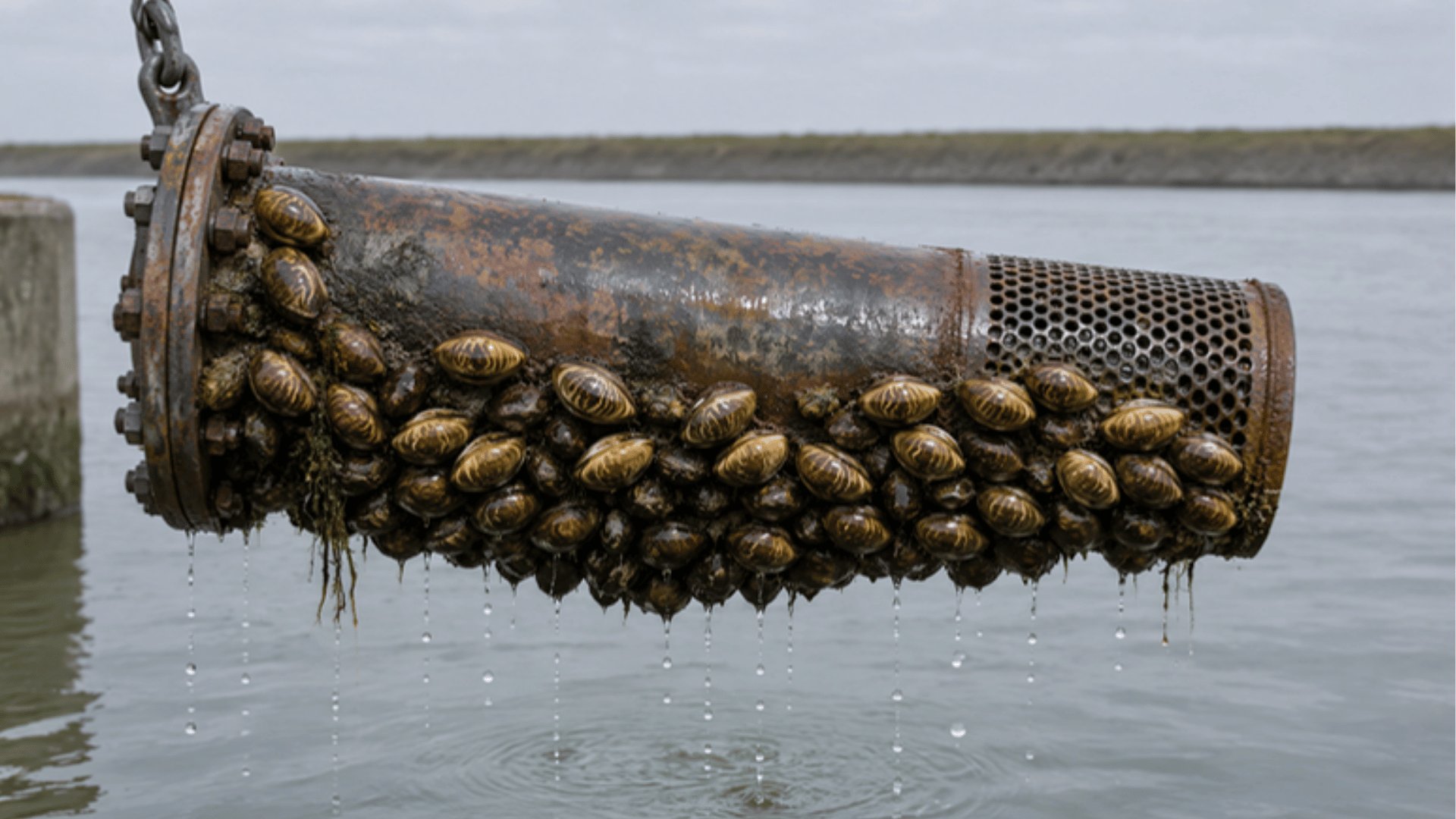
Two years ago nobody in California had seen a golden mussel. Today the fingernail-sized shellfish has spread more than 500 miles through the state's waterways, is growing on the intake screens that feed Stockton's drinking water, and has been confirmed in the Sacramento River at West Sacramento. On October 30, the Governor's Office of Emergency Services turned down a county's request for an emergency declaration, writing that there is no long-term solution. So what does a mussel in the river mean for the water in your kitchen? Less than you might fear, but more than nothing.
How a mussel crossed the state in two years
The golden mussel, native to China and Southeast Asia, was first found in North America at the Port of Stockton in October 2024, according to the California Department of Water Resources. By June 25, 2026, the Department of Fish and Wildlife had confirmed it near the Jefferson Boulevard overpass in West Sacramento, and Western Water reports it has pushed as far south as San Diego through the canals and aqueducts that move Delta water around the state.
It moves fast because it breeds fast. A single female can produce up to a million offspring a year, San Joaquin County officials told ABC News. The microscopic larvae, called veligers, drift wherever the water goes, which is why the state says it cannot screen them out of the State Water Project. A DWR spokesman told SJV Water that one copper treatment of a 300-mile stretch of aqueduct would cost an estimated $424 million.
Sacramento, San Joaquin, Yolo and Kern counties have all declared local emergencies. Kern County alone estimates it will spend more than $36 million a year fighting the mussel, which is why it asked the state for help. CalOES said no, tying the decision to the lack of any permanent fix.
What mussels do to a water system
Golden mussels attach to hard surfaces in dense clusters and never let go. For a water utility, that means intake screens, pipes, strainers, pumps and valves. Stockton's deputy director of water resources told the city council that the screens on the intake pipes feeding the city's drinking water were 30 to 40 percent covered, Western Water reported. In San Jose, the Santa Clara Valley Water District found a juvenile mussel in the raw-water intake of one treatment plant and an adult in a strainer at another last spring.
Utilities fight back mostly before the water is treated. Crews scrape, pressure-wash and send divers to clean the hardware. Chemically, the standard tools are oxidizers like chlorine and chlorine dioxide, plus copper and potassium salts, dosed at the intake to kill larvae before they settle, according to the Bureau of Reclamation's mussel management guide. When Austin, Texas, faced zebra mussels, the city added copper-ion systems at the front of all three treatment plants, with the copper removed later in the process.
What that can mean at your tap
Here is the important part for a homeowner: the mussel itself never reaches your faucet. Your treatment plant removes it along with everything else that size. The effects you might notice are indirect.
The first is taste and odor. When a mussel colony dies off, whether from treatment or a seasonal change, the decaying tissue can give water an earthy, fishy or musty note. Austin Water added more frequent taste-and-odor checks for exactly that reason.
The second is more chlorine. Pre-chlorinating the intake is one of the oldest, cheapest ways to keep mussels off the hardware. Researchers who monitored three Lake Ontario treatment plants wrote in the journal AQUA that utilities try to keep those doses as low as possible, partly to limit the chlorination byproducts that end up in tap water. More chlorine upstream can mean a stronger pool smell at the tap, the dry hair and dry skin that go with it, and more of the trihalomethanes we wrote about earlier this week.
For now, Folsom Lake, which supplies much of Placer and El Dorado counties, remains mussel-free. A boat covered in golden mussels was intercepted at a Folsom decontamination site in August, and state parks officials credited inspections for keeping it out of the water. The Sacramento River, though, already has the mussel, and the City of Sacramento draws from both the Sacramento and American rivers.
How to check your own water
Look up your utility's 2025 Consumer Confidence Report and find the lines for total trihalomethanes and chlorine residual; those are the numbers most likely to shift if a utility changes how it treats its intake. The EWG Tap Water Database lets you search by zip code and compare year to year.
At home, a whole-house carbon filter is designed to address chlorine, chloramine, sediment and taste-and-odor compounds, while a softener handles the hardness river and lake water carry. Reverse osmosis for drinking water is designed to address dissolved contaminants such as nitrates, PFAS and lead. None of that is a response to the mussel itself; it is a response to what gets added to the water to keep the mussel out.
Curious what's in your water? Book a complimentary water test — about 30 minutes, no obligation.
Healthier water, healthier family.
Sources
- SJV Water, "State refuses to declare golden mussel emergency because there is no 'long-term solution'," Oct. 30, 2026 — https://sjvwater.org/state-refuses-to-declare-golden-mussel-emergency-because-there-is-no-long-term-solution/
- Western Water, "Golden mussels tighten grip on California's water," July 7, 2026 — https://www.western-water.com/2026/07/07/golden-mussels-tighten-grip-on-californias-water/
- ABC News, "An 'out of control' species of mussel is threatening California's water infrastructure," April 2026 — https://abcnews.com/US/control-invasive-species-threatening-californias-water-supplies/story?id=132533503
- KCRA, "Boat with invasive golden mussels intercepted at Folsom Lake decontamination site," Aug. 17, 2026 — https://www.kcra.com/article/invasive-golden-mussels-boat-folsom-lake-decontamination-site/73447165
- KGET, "State declines to issue state of emergency over Golden Mussel invasion," Nov. 6, 2026 — https://www.kget.com/news/state-declines-to-issue-state-of-emergency-over-golden-mussel-invasion/
- U.S. Bureau of Reclamation, "Mussel Management Options," 2022 — https://www.usbr.gov/mussels/docs/Mussel-Management-Options-2022.pdf
- Austin Water, "Council approves construction contract for Zebra Mussel deterrent systems at all 3 water treatment plants," 2022 — https://austintexas.gov/node/71978
- AQUA – Water Infrastructure, Ecosystems and Society, "Zebra and quagga mussel veliger presence and settlement at Lake Ontario drinking water intakes," 2021 — https://iwaponline.com/aqua/article-pdf/70/4/537/898752/jws0700537.pdf