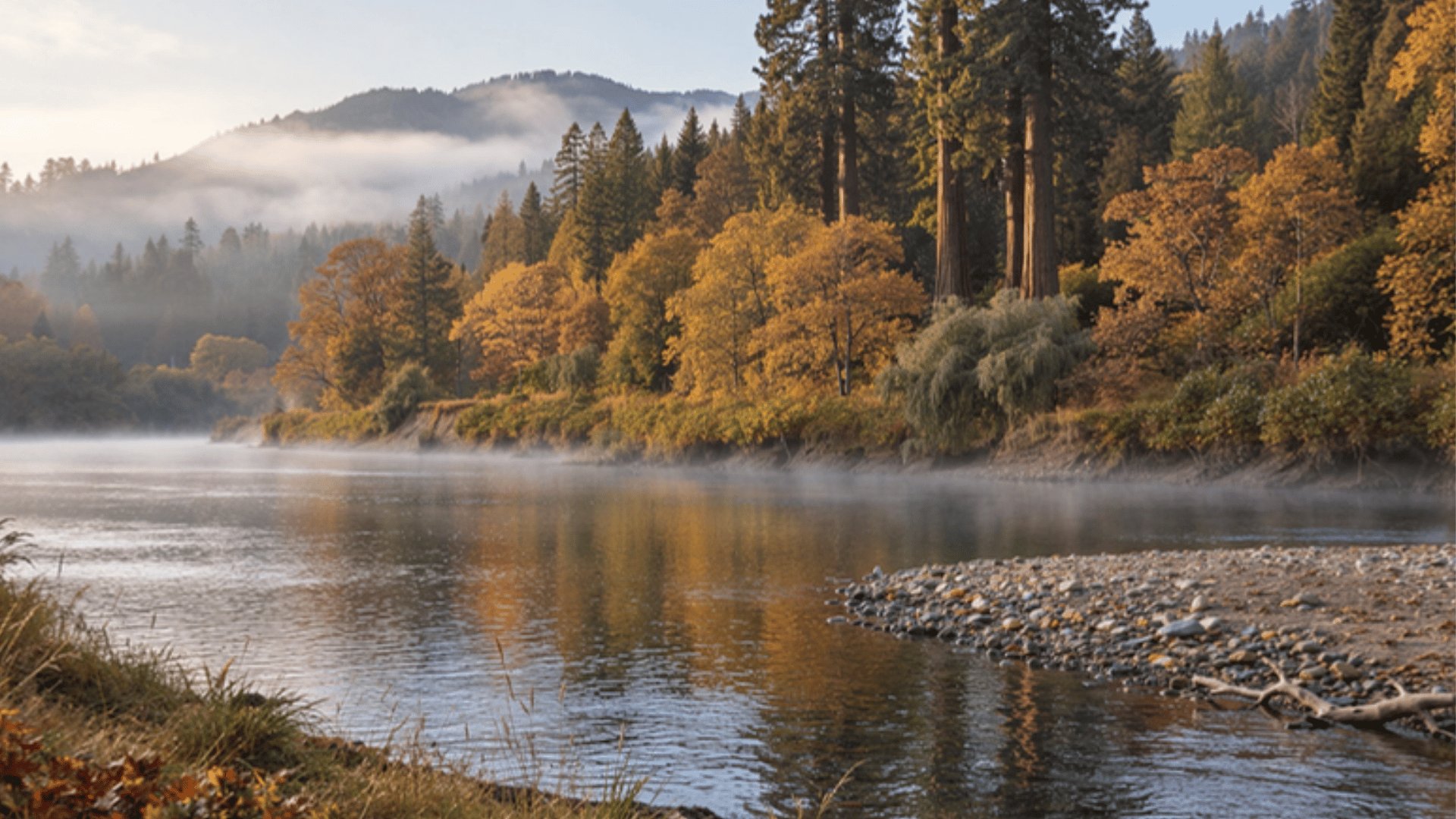
The first big storms of the El Niño winter have been soaking the North Bay this week, and the two reservoirs that feed most of Sonoma and northern Marin counties are finally expected to start rising. It is a good moment to answer a question most people never think about: when you turn on a tap in Santa Rosa, Petaluma, Rohnert Park or Novato, where did that water come from, and what happened to it on the way?
The short version: it came down the Russian River, soaked through about 80 feet of gravel, picked up chlorine and a pH adjustment, and arrived at your house moderately hard. Here is the longer version.
Two reservoirs, one river, 700,000 people
The Press Democrat reported on November 19 that Lake Sonoma, the region's largest reservoir, held 222,823 acre-feet of water, about 88% of its seasonal target, while Lake Mendocino had 45,466 acre-feet, or roughly 57%. Sonoma Water's spokesperson said Lake Sonoma is close to where it sat a year ago, but Lake Mendocino is at its lowest since 2024. Together with Lake Pillsbury farther north, the lakes supply a system serving about 700,000 customers from Mendocino County through Sonoma County into northern Marin.
The two reservoirs are not equals. A State Water Board order on Sonoma Water's water rights puts Lake Mendocino's water-supply pool at about 68,400 acre-feet and Lake Sonoma's at about 245,000. That is why Lake Sonoma can carry the region through more than one dry year and Lake Mendocino cannot. Water released from both flows down the Russian River to a stretch near Forestville, where the work of making it drinkable begins.
The river does the filtering
Sonoma Water does not pull water straight out of the river. It operates six collector wells beside the Russian River near Wohler Bridge and Mirabel. Each is a concrete caisson, 13 to 18 feet across, sunk roughly 80 feet below the riverbed, with horizontal arms that draw water from the sand and gravel underneath. Sonoma Water calls this river bank filtration: the water has already passed through tens of feet of natural aquifer before a pump touches it.
That natural filtration removes sediment and most microorganisms, which is why the water needs no conventional treatment plant. Two things are still added. Chlorine keeps the water disinfected across the aqueducts that carry it to nine cities and water districts. Sodium hydroxide raises the pH from the river's natural 7.1 to 7.6 up to a target of 8.2 to 8.6, because Russian River water is naturally a little corrosive to the copper and lead in older household plumbing.
Not every city gets the same blend. Santa Rosa's 2025 water quality report says 95% of its supply is Russian River water. Rohnert Park mixes in about 40% from its own wells. North Marin Water District in Novato draws about three-quarters from the Russian River and the rest from Stafford Lake. Petaluma relies on the aqueduct too, topped up with local groundwater in summer.
What the tests show at a North Bay tap
The Forestville Water District sits next to the collector wells and serves Sonoma Water's supply essentially unblended, so its 2025 Consumer Confidence Report is a clean snapshot of what the river delivers:
- Hardness: 110 parts per million, ranging from 106 to 125. That is about 6.4 grains per gallon, which the USGS classifies as moderately hard, and the top of the range crosses into hard. It is the mineral content behind spotty glassware, scale on the showerhead and a water heater that slowly fills with sediment.
- Chlorine residual: 0.93 milligrams per liter on average, ranging from 0.64 to 1.68. That residual keeps the water safe in the pipes, and it is also what people notice as a faint pool smell, dry skin after a shower and hair that feels brittle.
- Total trihalomethanes: 16 parts per billion, and haloacetic acids at 5.2. Both form when chlorine meets the small amount of natural organic matter left in river water.
- Lead: below 5 parts per billion at every home tested, which is where that pH adjustment earns its keep.
- Chromium-6: 0.37 parts per billion, a trace from the region's natural geology.
How to check your own water
Every North Bay city publishes a Consumer Confidence Report each summer; search your city name plus "water quality report." EWG's Tap Water Database lets you look up any zip code and see every contaminant detected in recent years. And to know what happens after the water passes the meter, in your own pipes and water heater, a test at the kitchen tap is the only way to find out.
For homes on this supply, the things worth addressing are the ones above: whole-home carbon filtration takes out the chlorine and its taste and odor, a softener handles the 110 ppm of hardness scaling up appliances, and reverse osmosis under the sink polishes drinking water of dissolved leftovers, including trihalomethanes, chromium-6 and anything the river picks up in a wet winter.
Curious what's in your water? Book a complimentary water test — about 30 minutes, no obligation.
Healthier water, healthier family.
Sources
- The Press Democrat / Sonoma Index-Tribune, "As rains saturate parched watershed, North Bay reservoirs to see water levels begin to tick up," November 19, 2026 — https://www.sonomanews.com/2026/11/19/north-bay-reservoir-levels/
- Sonoma Water, "Water Supply" (collector wells, pH adjustment) — https://www.sonomawater.org/water-supply
- Sonoma Water, "Water Quality" (river bank filtration, chlorine, pH target) — https://www.sonomawater.org/water-quality
- Forestville Water District, "2025 Consumer Confidence Report," July 1, 2026 — https://www.forestvillewd.com/files/8698715e6/CCR-2025+FWD.pdf
- City of Santa Rosa, "2025 Water Quality Report," June 2026 — https://www.srcity.org/DocumentCenter/View/50278/2025-Santa-Rosa-Water-Quality-Report-Reported-June-2026-PDF
- North Marin Water District, "2025 Annual Water Quality Report, Novato Edition," June 2026 — https://nmwd.com/wp-content/uploads/2026/06/NMWD-2025-Annual-Water-Quality-Report-Novato-English-Online.pdf
- State Water Resources Control Board, "Order on Sonoma Water Temporary Urgency Change Petitions," March 2026 — https://www.waterboards.ca.gov/waterrights/water_issues/programs/petitions/docs/2026/2026-03-sonoma-water-tucp-order.pdf
- City of Rohnert Park, "Water Quality Report" (supply blend) — https://rpcity.org/Archive.aspx?ADID=2116