Since last Friday night, a few hundred households in West San Martin, the rural stretch of Santa Clara County between Morgan Hill and Gilroy, have been boiling every pot of water they drink. California American Water found E. coli in its Zone 1 system on November 7 and issued a boil-water notice at 9 p.m. the same day. It's a small event on the map, but a clear window into what a boil-water notice is really telling you, and what to do in your own kitchen when one arrives.
What happened in San Martin
The affected area sits west of Highway 101, between Monterey Road and Santa Teresa Boulevard. Cal Am's notice says E. coli was found in the supply on November 7 and lists two corrective steps: flushing the pipes in Zone 1 and chlorinating the system as soon as possible. The utility estimated about six days to resolve, with a target of November 13. In a November 11 update it said it was adding chlorine to water entering Zone 1 and working with the state Division of Drinking Water, according to Medical Daily.
ABC7 San Francisco reports that officials require two clean tests taken 48 hours apart before the advisory can be lifted, and that free bottled water is available at the county's Animal Services Center from 2 to 8 p.m. daily until then. Several residents told ABC7 and KRON4 they believe they got sick before the notice went out, though health officials have not confirmed any illness linked to the water.
What E. coli in a water system is telling you
E. coli lives in the intestines of warm-blooded animals, including people, and most strains are harmless on their own. Utilities test for it because it's an indicator: finding it in a public water system means the water "may be contaminated with human or animal wastes," as the State Water Board's standard notice puts it, and other germs could be along for the ride. Those germs typically cause short-term stomach trouble, and the risk is higher for infants, young children, older adults and anyone with a weakened immune system.
Cal Am's notice also explains how bacteria get into a system: runoff can reach the source after heavy rain, a pipe can break, or a treatment step can fail. That's why public systems sample for coliform bacteria on a routine schedule, and why a confirmed E. coli result triggers an urgent notice rather than a line in next year's report.
Why the answer is "boil," and why a filter doesn't replace it
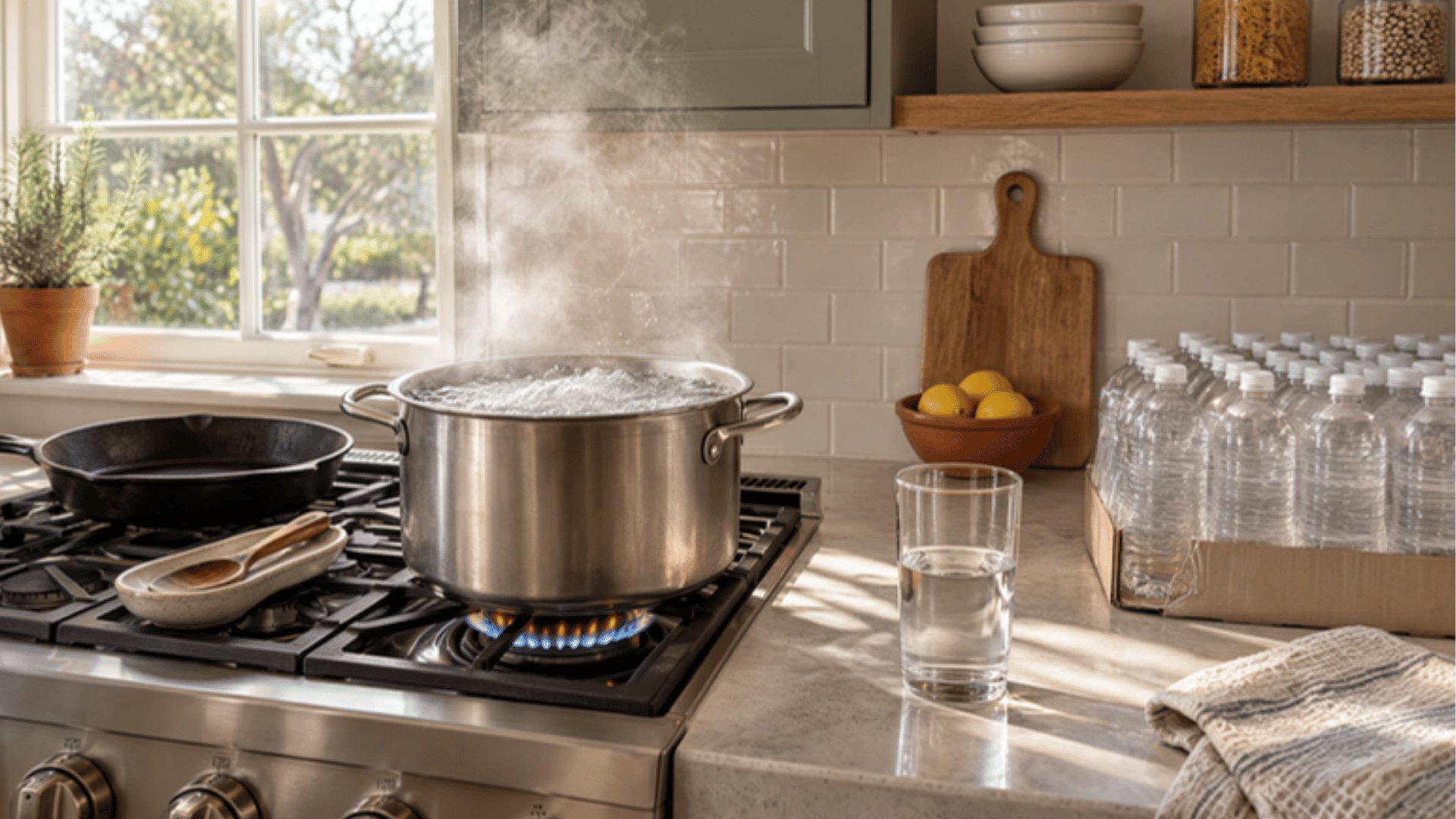
The CDC's instruction during a boil-water advisory is simple: bring tap water to a full rolling boil for one minute (three minutes above 6,500 feet), let it cool, and use that or bottled water for drinking, cooking, making ice, brushing teeth and washing produce. Two details catch people off guard. First, the CDC says to boil your tap water even if it has been through a home filter or a filter pitcher. Second, it says not to use water from any appliance connected to your water line during the advisory, including the refrigerator dispenser and ice maker, and to throw out ice made since the notice began.
Here's the reason. Most household filtration is designed for what's in water on a normal day: chlorine and chloramine, sediment, hardness, and the taste and odor that come with them. Reverse osmosis goes further and is designed to address dissolved contaminants such as nitrates, PFAS and lead. None of that is a substitute for disinfection when bacteria are loose in a pipe network, which is exactly what a boil notice is about. Boiling kills the germs; a carbon filter or an RO membrane is not what you rely on for that job.
There's a flip side, too. The fix Cal Am is applying in San Martin, extra chlorine, is the same chemical most of us drink and shower in every day at lower levels. It keeps bacteria out of the pipes between the plant and your tap, and it's also why tap water can taste like a pool and leave hair and skin dry. Taking chlorine out at the house is one of the main things whole-home filtration is for, after the water has done its disinfecting work in the pipes.
How to check your own water
Three habits make a boil notice far less stressful if one lands on your street. Sign up for your utility's alert system; Cal Am's notice went out by text and phone the night it was issued. Read the Consumer Confidence Report your utility publishes each year, and look up your zip code in EWG's Tap Water Database to see what's been detected over time. And if you rent, know that under California Health and Safety Code section 116450(g), landlords must pass a notice like this to tenants within 10 days.
Once a notice is lifted, flush your cold taps for a few minutes, dump the ice, and replace filter cartridges that were in service during the event. A test at your own tap tells you the rest: how hard your water is, how much chlorine arrives at your home, and whether anything from your own plumbing shows up.
Curious what's in your water? Book a complimentary water test — about 30 minutes, no obligation.
Healthier water, healthier family.
Sources
- California American Water, "San Martin: Boil Water advisory: Monterey Rd," November 7, 2026 (updated November 11, 2026) — https://alertsdetail.awapps.com/alert/144362
- ABC7 San Francisco, "E. coli contamination leaves San Martin residents under boil water advisory," November 12, 2026 — https://abc7news.com/story/coli-contamination-leaves-san-martin-residents-boil-water-advisory/20034098/
- KRON4, "San Martin residents seek answers after E. coli detected in drinking water," November 12, 2026 — https://www.kron4.com/news/bay-area/san-martin-residents-seek-answers-after-e-coli-detected-in-drinking-water/
- Medical Daily, "E. Coli Found in West San Martin Water System Keeps Hundreds Under Boil Advisory in Santa Clara County," November 12, 2026 — https://www.medicaldaily.com/west-san-martin-e-coli-boil-water-notice-481177
- Centers for Disease Control and Prevention, "Drinking Water Advisories: An Overview" — https://cdc.gov/water-emergency/about/drinking-water-advisories-an-overview.html
- State Water Resources Control Board, Tier 1 E. coli public notice template — https://www.waterboards.ca.gov/drinking_water/certlic/drinkingwater/documents/notices/t1_e_coli_notice.docx