
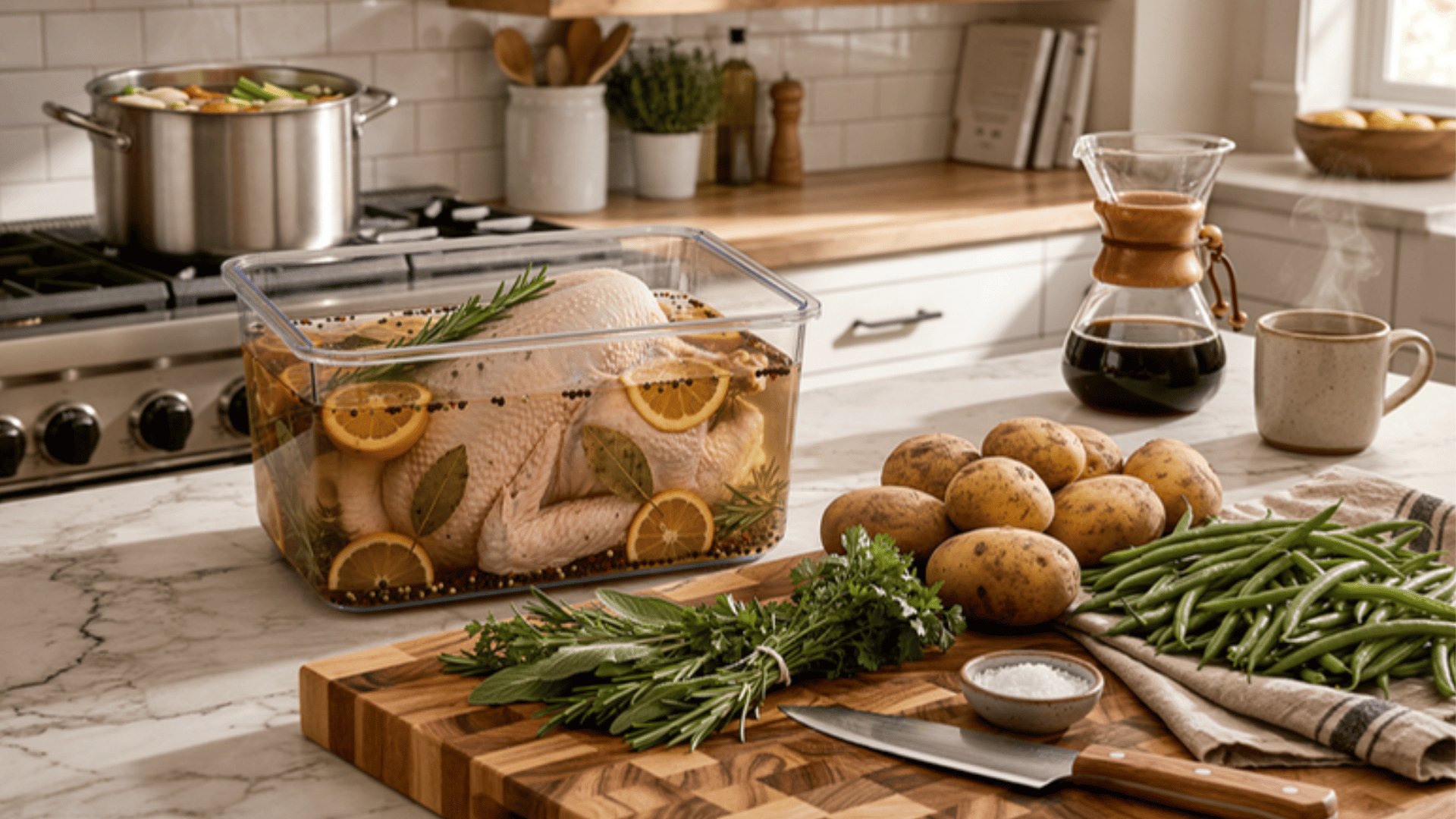
On Thursday, most of us will run more water through the kitchen than on any other day of the year: a stockpot for the brine, another for the potatoes, a pot of beans, and a coffee maker working overtime through dessert. Water is the one ingredient nobody measures. But it quietly decides how fast the beans soften, what color the cauliflower turns, and whether the coffee tastes like the bag promised. Here's what's actually happening in the pot.
Water is an ingredient, and around here it changes street by street
Most Sacramento-area homes get water from two very different places: Folsom Lake and the American River on one hand, and groundwater wells on the other. Those sources carry very different amounts of dissolved calcium and magnesium, which is what "hardness" means.
Roseville's 2025 Water Quality Report shows how wide the swing can be. Water treated from Folsom Lake averaged 26 parts per million (ppm) of total hardness last year, while the city's groundwater wells ranged from 31 all the way up to 280 ppm. On the U.S. Geological Survey's scale, anything above 180 ppm counts as "very hard." Sacramento Suburban Water District, which also blends lake water and well water, tells its customers that on any given day they may be getting surface water, groundwater, or a mix, so hardness levels change through the year.
Translation: the water you cook with this Thursday may not be the water you had in July. And across Placer, El Dorado, Sacramento, Sonoma and Marin counties, the answer depends on your utility, your neighborhood and which wells are running.
What hard water does on the stove
Hardness is harmless to drink. In the kitchen, though, it shows up in three familiar ways.
Beans and lentils take longer. Colorado State University Extension warns against soaking pulses in hard water because the minerals can keep them from softening. Cooking trials at Red River College in Canada put a number on it: kidney beans took 70 percent longer to cook in hard water than in distilled water. If your green-bean casserole or pot of beans never quite gets tender, the water is a likely suspect.
White vegetables lose their color. Hard water is alkaline, and the University of Illinois Extension notes that hard water and overcooking together turn white vegetables like potatoes, cauliflower and onions a dull yellow or gray. A squeeze of lemon in the cooking water helps because it pushes the pH back toward neutral.
Scale builds up where water gets hot. Kettles, coffee makers, dishwashers and the water heater that feeds the whole kitchen all collect mineral scale from hard water. Spotty glassware after the big dinner is the same chemistry at work.
The chlorine in the brine, and in the coffee
Every public water system in California adds a disinfectant so water stays safe between the treatment plant and your tap. Roseville's 2025 report shows a chlorine residual that averaged 0.78 ppm in the distribution system, with readings up to 1.68 ppm. That's well under the 4 ppm limit, and it's doing an important job.
It just isn't a flavor you want in the food. A wet-brined turkey sits in tap water for hours. The Specialty Coffee Association's brewing-water standard calls for zero chlorine and about 150 milligrams per liter of dissolved minerals, because chlorine flattens coffee's aroma and too little mineral content makes it taste thin. Chlorine is also the reason showers leave hair and skin feeling dry, so a water that tastes "off" in the coffee is usually the same water drying out your hands at the sink.
Chlorine tends to dissipate when water is heated or left standing. Chloramine, a more stable form that some utilities use instead, does not leave as easily, which is one reason some homes notice the taste more than others.
How to find out what's coming out of your tap
Start with your zip code in the Environmental Working Group's Tap Water Database, which lists what each utility detected in its most recent tests. Then open your utility's annual Consumer Confidence Report; the secondary-standards table lists total hardness, calcium, magnesium and the chlorine residual for your system. Roseville's report also repeats a simple kitchen rule worth following every day, not just Thursday: use only cold water for drinking and cooking, since hot water picks up more from pipes and the water heater.
If you want to change the water itself, the tools map neatly onto the problems above. A whole-home filter is designed to take out chlorine or chloramine, sediment and taste-and-odor compounds before water reaches any faucet or shower. A softener is designed to address hardness, which is the beans, the dull vegetables and the scale. And a reverse osmosis system at the kitchen sink is designed to reduce dissolved contaminants such as nitrates, PFAS and lead in the water you drink and cook with, which is the water that ends up in the brine and the coffee pot.
Curious what's in your water? Book a complimentary water test — about 30 minutes, no obligation.
Healthier water, healthier family.
Sources
- City of Roseville Environmental Utilities, "2025 Water Quality Report," June 4, 2026 — https://rosevilletoday.com/wp-content/uploads/2025/07/Roseville-Water-Quality-Report-2025.pdf
- City of Roseville, "New water quality report now available," June 4, 2026 — https://www.roseville.ca.gov/articles/New-water-quality-report-now-available-746.php
- Sacramento Suburban Water District, "Hard Water" — https://www.sswd.org/departments/water-quality/hard-water
- U.S. Geological Survey Water Science School, "Hardness of Water" — https://www.usgs.gov/special-topics/water-science-school/science/hardness-water
- Colorado State University Extension, "Tips for Cooking with Dry Beans and Other Pulses" — https://extension.colostate.edu/resource/cooking-with-dry-beans-and-other-pulses
- Red River College Research Partnerships & Innovation, "Spilling the Beans: to salt or not to salt?" June 4, 2020 — https://www.rrc.ca/ar/2020/06/04/spilling-the-beans-to-salt-or-not-to-salt/
- University of Illinois Extension, "The Whys and Hows of Cooking Vegetables," Sept. 5, 2014 — https://extension.illinois.edu/sites/default/files/the_whys_and_hows_of_cooking_vegetables.pdf
- Specialty Coffee Association, "Water for Brewing Specialty Coffee" (Heritage Coffee Standards), Nov. 21, 2009 — https://www.sca.coffee/heritage-coffee-standards
- U.S. EPA, "Chloramines in Drinking Water" — https://www.epa.gov/dwreginfo/chloramines-drinking-water