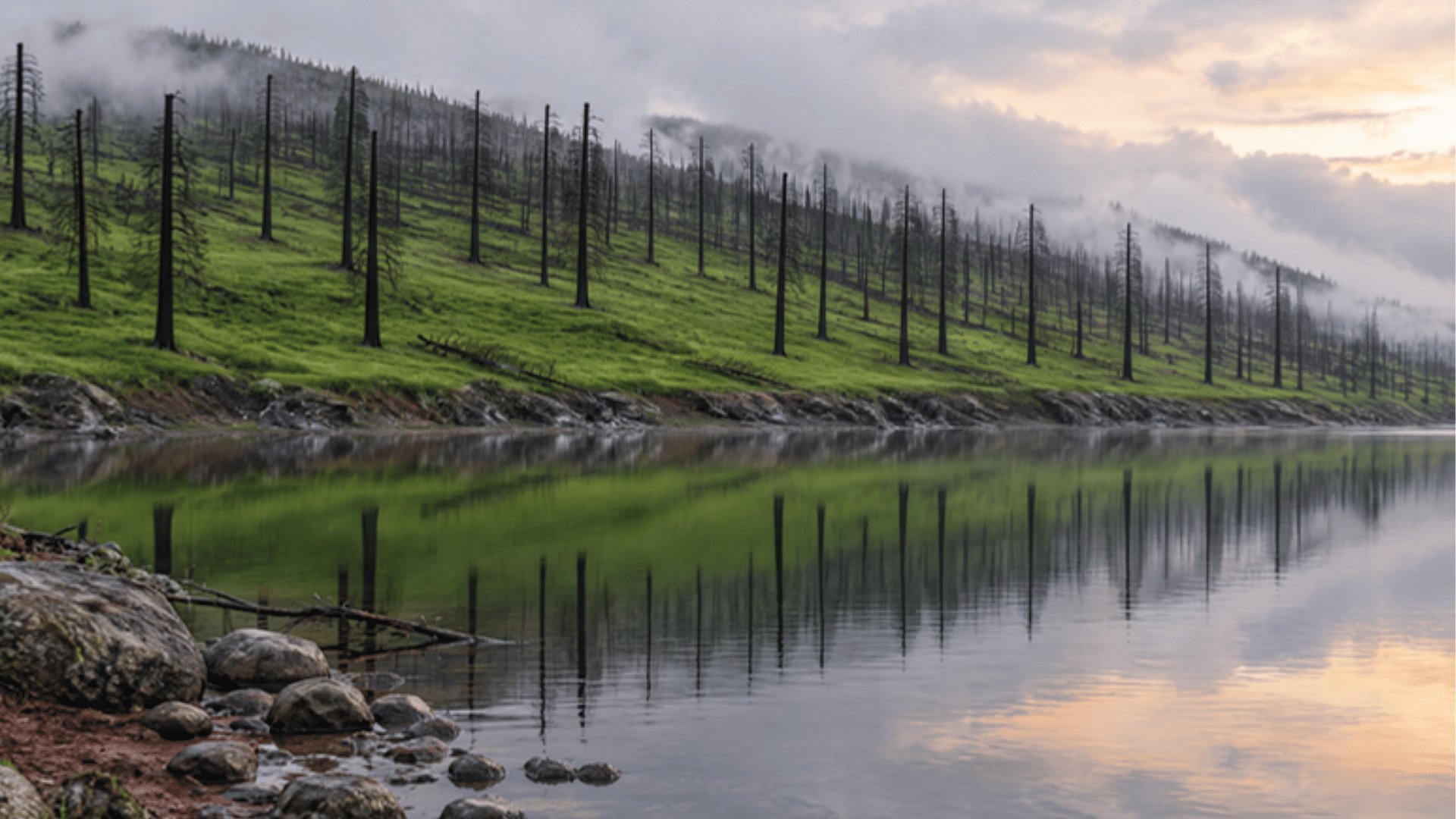
This weekend's rain is the first real storm of the El Niño winter for the Sacramento region. Up in the Sierra, it is also the first big flush of the season across more than 285,000 acres of the American River watershed that burned in the Caldor and Mosquito fires. A new Associated Press report this week pulls together what scientists have learned about what happens when that ash washes into the rivers and reservoirs that feed our taps, and the short version is that the effects last far longer than most of us assume.
What the new research says
The AP story, published November 13, starts with a big number: so far in 2026, the United States has recorded 68,179 wildfires that burned more than 14,062 square miles. That matters for drinking water because forested watersheds supply nearly two-thirds of U.S. municipalities, according to Carli Brucker of the University of Colorado Boulder, lead author of a study that compared water quality in hundreds of burned basins with unburned ones. Her team found the effects can last up to eight years.
The reason is that a healthy forest is a natural filter. Trees and soil slow rain down and strain it before it reaches a stream. Once a hillside burns, rain carries ash, fine sediment and dissolved organic matter straight into the creek, along with a spike in metals that treatment plants were not designed to handle, Brucker told the AP. Reservoirs help by letting particles settle, but burned sediment is loaded with nitrogen and phosphorus, and Gonzaga University's Kyle Shimabuku explained that those nutrients feed algae as the water sits.
There is a chlorine connection too. Garrett McKay of Texas A&M told the AP that when a plant disinfects water rich in fire-derived organic matter, the chlorine reacts with it to form disinfection byproducts, the same trihalomethanes we wrote about earlier this week. Because a plant cannot remove those byproducts after the fact, it has to strip out the organic matter first, which can slow the supply.
The story's cautionary example is Las Vegas, New Mexico, which lost its water supply for months after the 2022 Hermit's Peak/Calf Canyon fire burned the Gallinas River watershed. A 2024 flood pushed more burn debris into the town's reservoirs and left it with only a few days of safe water. State and federal governments ultimately committed $148 million to rebuild the treatment plant.
Why Folsom Lake is part of this story
Nearly everyone in Folsom, Granite Bay, Roseville, El Dorado Hills and much of Sacramento drinks water that passes through Folsom Lake or the American River. A February 2025 report for the El Dorado Water Agency put the fire footprint plainly: the Caldor Fire burned 208,561 acres in 2021 and the Mosquito Fire burned 77,178 acres in 2022, together more than 285,000 acres of the upper American River watershed, or nearly 20 percent of it. The U.S. Geological Survey is now tracking Folsom Lake specifically because of those two fires.
Local water managers saw the effects quickly. When rain slowed the Mosquito Fire in September 2022, KCRA reported that runoff was already carrying ash into the Middle Fork of the American River, and Placer County Water Agency general manager Andy Fecko described adding extra treatment steps to pull those particles out before water reached homes. A 2025 study in an American Geophysical Union journal that tracked Caldor Fire sediment into Jenkinson Lake found the treatment plant below Sly Park Dam needed extra turbidity controls in both 2021 and 2022, and that far more sediment came down in the second winter, once heavier rain and salvage logging disturbed the burned slopes.
What that can look like at the tap
Post-fire water rarely looks dramatic by the time it reaches a kitchen. The changes tend to be subtle: a slightly earthier taste or smell when algae gets a foothold, a touch of cloudiness after a big storm, and more chlorine in the system as plants work harder to disinfect water carrying more organic matter, which many people notice first as drier hair and skin. Metals that ride in on ash, such as manganese and iron, can tint water or stain fixtures. Sonoma County has seen a different pathway: after the 2017 Tubbs Fire, heat-damaged plastic pipes released benzene into Santa Rosa's distribution system, and the cleanup topped $44 million, according to an AWWA Water Science study co-authored by Purdue's Andrew Whelton.
A whole-home carbon filter is designed to address chlorine, chloramine, sediment and taste-and-odor compounds, which covers most of what fire runoff changes in treated water. Reverse osmosis at the kitchen tap is designed for dissolved contaminants a carbon filter is not built for, including metals, nitrates, PFAS and the byproducts that form when chlorine meets organic matter.
How to check your own water
Your utility's annual Consumer Confidence Report lists trihalomethanes, haloacetic acids, turbidity and manganese for the past year; San Juan Water District, Folsom and Roseville all post theirs online. The EWG Tap Water Database shows the same results by zip code. And because fire effects arrive in bursts after storms, a test at your own tap in the week after a big rain tells you more than an annual average will.
Curious what's in your water? Book a complimentary water test — about 30 minutes, no obligation.
Healthier water, healthier family.
Sources
- Associated Press (via OPB), "Bigger and more-frequent wildfires threaten water supplies across the US," November 13, 2026 — https://www.opb.org/article/2026/11/13/water-supply-contamination-wildfire/
- El Dorado Water Agency, "Natural Capital Damages from the Mosquito and Caldor Fires," February 2025 — https://www.edwateragency.org/files/assets/wateragency/v/1/documents/202502-uarw-natural-capital-damages-from-wildfires.pdf
- KCRA 3, "As rain quiets activity on the Mosquito Fire, water managers in Placer County prepare for years of water quality challenges," September 2022 — https://www.kcra.com/article/rain-mosquito-fire-water-managers-placer-county-prepare-years-water-quality-challenges/41320250
- East et al., AGU, "Post-Fire Sediment Yield From a Western Sierra Nevada Watershed Burned by the 2021 Caldor Fire," January 2025 — https://cawaterlibrary.net/wp-content/uploads/2025/01/East-et-al-125-AGU.pdf
- U.S. Geological Survey, "Assessing impacts of wildfire on water and habitat quality in downstream aquatic ecosystems using remote sensing" — https://www.usgs.gov/centers/california-water-science-center/science/assessing-impacts-wildfire-water-and-habitat
- NRDC, "Wildfires Can Spark Widespread Contamination of Public Water Supplies," 2020 — https://www.nrdc.org/stories/wildfires-can-spark-widespread-contamination-public-water-supplies
- Sacramento Bee, "Atmospheric river arrives in California with rain, wind. Here's how much is coming," November 13, 2026 — https://www.sacbee.com/latest-news/article318046562.html