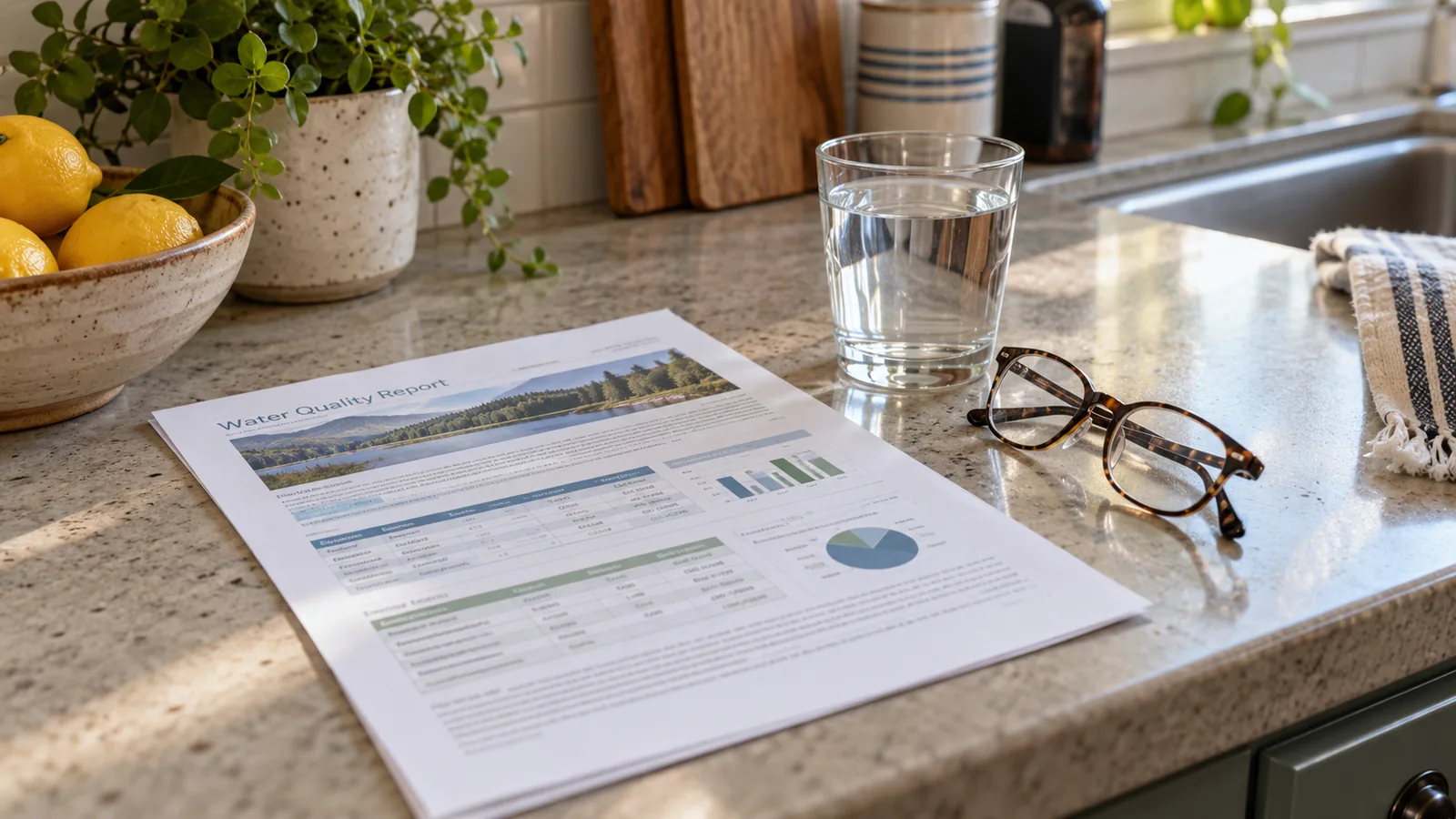
Your water report has useful answers buried in tables and abbreviations. Start with the supplier, the measured results, and the units beside each number. We’ll walk through what those entries mean for the water you drink and use at home.
What the report is
It's called a Consumer Confidence Report (CCR). Utilities must deliver it each year by July 1, covering the previous calendar year (Illinois EPA, summarizing the federal rule). In California, the report must list each detected contaminant's level alongside its Public Health Goal and its legal limit (OEHHA).
To find yours, search your city or water district name plus "water quality report." It's usually a PDF on the utility's website.
The three numbers that matter
| Term | What it means | Enforceable? |
|---|---|---|
| MCL (Maximum Contaminant Level) | The legal limit your utility must meet | Yes |
| PHG (Public Health Goal, California) | The level with no significant health risk over a lifetime, set on health alone | No |
| MCLG (federal goal) | EPA's health-based goal, similar in spirit to a PHG | No |
Legal limits and health goals answer different questions. California sets enforceable limits after weighing health protection, treatment cost and technical feasibility, while a Public Health Goal is based on health evidence alone (OEHHA). That distinction matters: water can meet the legal standard while a detected contaminant remains above California's health goal.
For cancer-causing chemicals, the PHG is typically set at a one-in-a-million risk level, assuming someone drinks the water daily for 70 years (OEHHA).
Why "meets standards" may not be your family's finish line
Water that meets every MCL is legally compliant. But compliance is a system-wide regulatory baseline, not a promise of zero exposure and not a personalized water-quality goal for every household (OEHHA).
A PHG is the level California considers health-protective without factoring in treatment cost or technical feasibility. For families who want to reduce avoidable exposure at the tap—especially households with young children or someone pregnant—the distance between the detected level and the health goal is worth paying attention to.
Where EWG fits in
The Environmental Working Group's Tap Water Database covers nearly 50,000 community water systems and compares detected levels with legal limits and health guidelines. Its guidelines are based only on protecting health and don't factor in treatment cost (EWG).
That health-first lens is why EWG's numbers are often much lower than legal limits. For example, the EPA limit for haloacetic acids (HAA5) is 60 ppb, while EWG's guideline is 0.1 ppb (EWG). EWG helps families see not only whether a utility passed its compliance test, but how detected levels compare with a health-focused benchmark.
Use EWG alongside your utility's report. The utility report shows the official compliance picture; EWG makes the same public data easier to explore and highlights where you may want additional protection at your own tap.
A five-minute way to read your report
- Check the violations section first. Any MCL violation must be disclosed with a plain health statement.
- Find the disinfectant. Chlorine or chloramine, and the average level.
- Scan disinfection byproducts. Look for TTHMs and HAA5, and compare the result to the PHG.
- Note hardness. It's often listed under "secondary" or "other" parameters, in mg/L or grains per gallon.
- Compare to the PHG column. Circle anything detected above its goal. That's your list of questions.
From the report to better water at home
Your utility report is a starting point. It describes water across the public system and averaged over time; it cannot show how the water tastes at your kitchen sink, what is happening in your plumbing, or the hardness and scale you experience every day. A complete home system gives you another layer of control: carbon filtration for chlorine-related taste and odor, softening for hardness scale, and kitchen reverse osmosis for dedicated drinking and cooking water.
Book a complimentary in-home water test. In about 30 minutes we'll screen for chlorine, check sediment and clarity, review your utility's report and PHG column, and show how the complete Family First Water system can improve water throughout your home and at the kitchen sink. See what the screening measures or call 916-751-1781.